Openers · Port Colborne
Garage Door Opener Diagnosis and Repair
You press the remote from the driveway and hear the motor hum overhead, a steady drone with no movement behind it. The door stays shut.
Garage Door Opener Diagnosis and Repair
In plain words
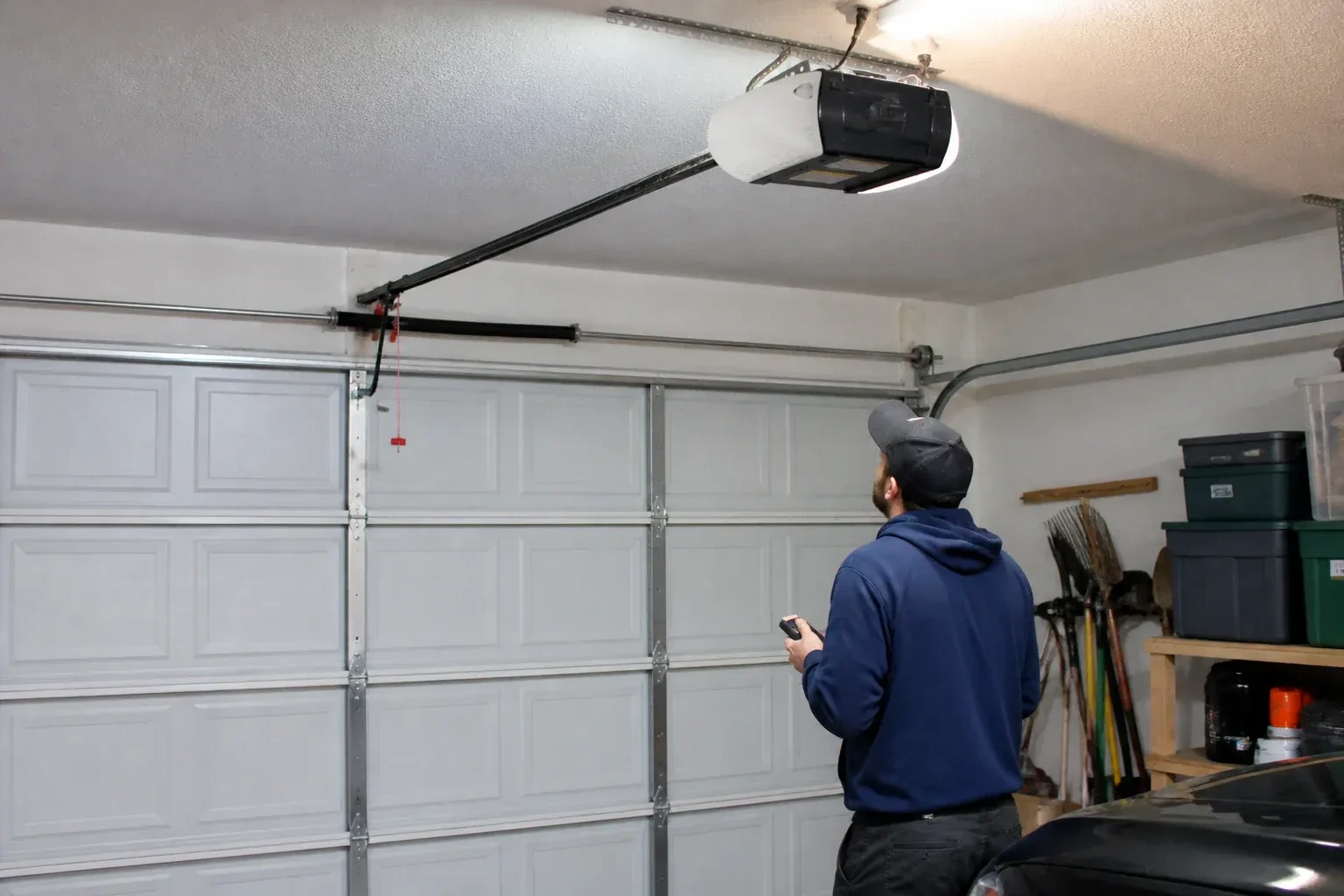
Most openers built in the last fifteen years report their own trouble. When something is wrong the head unit blinks its lights in a count, an up arrow and a down arrow flashing in a pattern, or a status light repeating a number. Each pattern has a meaning on the maker's chart for that model: a sensor circuit open, no motor movement detected, too much force needed to close. The technician reads the pattern, checks it against the model, and confirms it with a hands-on test rather than trusting the light alone. Older units without codes are diagnosed by ear, by meter and by hand.
How the visit goesThe door goes up perfectly. Coming down is the trouble: partway to the floor it stops, climbs back to the top, and the light on the opener blinks at you. The only way to close it is to stand inside holding the wall button the whole way down.
Port Colborne
How the visit goes
One control at a time
Each way of telling the door to move is tried on its own: the wall control, every remote, the outside keypad and, if fitted, the phone app. The pattern of what works tells a story. If the wall button works and nothing wireless does, the receiver, the remote batteries or a lock setting is suspect. If a remote works only up close, range and interference are the topic. If nothing at all works but the unit's light responds, the fault is downstream of the controls. The technician also checks the wall control's own indicator, which on most models blinks continuously when lock mode has been switched on by accident.
Re-engaging or rebuilding the drive
A trolley that was disconnected by the release cord is re-engaged: the door is placed by hand, the carriage is run to meet it, and the two latch together with an audible click. A stripped drive gear, the classic failure on chain-drive heads, is replaced as a kit: cover off, motor lifted, worn gear and sprocket out, new gear, sprocket, bushings and grease in, chain re-tensioned so it sags only slightly below the rail. A snapped or badly stretched chain or a frayed belt is replaced and tensioned. Each repair ends with a full open-and-close cycle while the technician watches the trolley for smooth, even travel.
Care between visits
An opener lasts longer when the door it moves stays easy to move. Twice a year, put a garage door lubricant on the rollers, hinges, bearings and springs; leave the track itself clean and dry so the rollers roll rather than slide. Wipe the sensor lenses and check their brackets have not been knocked. Glance at the chain for slack, and at the bolts holding the rail to the header and the ceiling. Listen for new sounds, since a grinding start or a squeal is the drive asking for attention while the fix is still a small one. None of this touches the springs, which stay a technician's job.
Garage Door Opener Diagnosis and Repair
In the van
- Start capacitor
- Wall control
- Logic board or receiver
- Drive gear and sprocket kit
- Bell wire and clips
What affects the quote
Same fees day, night or weekend
1Whether the door needs work first
If the by-hand check shows a heavy or binding door, the balance, rollers or springs are corrected before the opener is judged, and that door-side work is quoted as its own item.
2Wiring to be re-run
Damaged low-voltage wire to the sensors or the wall control is replaced along its whole length and clipped clear of the track, so the distance and route from head unit to door frame affect the time.
3Ceiling height and access
A standard-height garage puts the head unit in easy ladder reach. High ceilings, high-lift tracks, storage lofts or a car that cannot be moved add setup time and sometimes a taller ladder.
Garage Door Opener Diagnosis and Repair: questions
Why does the door stop just above the floor and reverse?
Two usual reasons. The travel limit is set a fraction too long, so the door reaches the slab, meets it harder than expected and interprets that as an obstruction. Or the bottom seal has stiffened or frozen and the last few centimetres take more force than the setting allows. Both are adjusted after the door is checked for balance, and the fix is confirmed by closing the door several times and running the contact reversal test.
Why does my door go back up when I try to close it?
The opener believes something is in the way. Either the photo-eye beam near the floor was broken, misaligned or blocked, or the door met more resistance than its force setting allows, often from a frozen seal, stiff rollers or a travel limit set slightly too long so the door hits the slab. The indicator light on the head unit usually tells which of the two it was, and the technician confirms it by testing rather than guessing.
How long does a diagnosis visit take?
The checks themselves run in a set order and take a modest part of an hour on most doors. What extends a visit is the repair that follows: a gear kit or capacitor adds a little, a sensor re-wire or a trolley change adds more, and a door-side problem such as a balance fault may mean a second piece of work. You are told where things stand once the cause is found, before any further work begins.
Openers & Access
- Belt-Drive Opener RepairPress the remote and the motor runs its full cycle, lights on, the usual whir, but the door does…
- Garage Door Opener ReplacementThe remotes only work from the end of the driveway now, and one of them disappeared with a set of…
- Photo-Eye Sensor Alignment or ReplacementOn bright mornings the door will not close, then by lunchtime it behaves itself.
Garage Door Opener Diagnosis and Repair near you
If your door in Port Colborne is doing something new, there is a service here for it. Grinding usually points to rollers or hinges. A door that will not lift points to a spring or cable. A door that reverses on its own points to sensors or force settings. We diagnose first, then repair.